Lesson 4 April 2021

Sometimes here in the northern climes we tend to put off things until “good weather” had arrived (which might not be until late May where I live) thinking that we will be able to do it better then. While I don’t think that I can plant a garden under 3 feet of snow, I can plan what I want to plant. But then when “good weather” comes I have so much to do I don’t do as good a job as I would like to. And sometimes it seems that I am overwhelmed by what needs to be done, that I don’t do things that are very important because so many things are calling for my attention.

This relates to the term “Tyranny of the Immediate”. So often we attend to the thing that needs to be done right now (answering the phone call that turns out to be a telemarketer) instead of something of greater value (reading the Bible a little longer). Human beings are all affected by this and I certainly believe that I get caught up in this much too often. So, how do we counteract this? “The main thing is to keep the main thing the main thing.” This advice comes from Jim Barksdale, CEO of Netscape, later AOL. It was developed for a business application, but still rings true in almost every group, including families.

Parenting is a tough, exhausting job! As a grandparent, looking on at the complexity of the work involved, I can see how easy it was when I was a parent and now that I look on at other parents, to get caught up in this “Tyranny of the Immediate” and so miss doing some of the things that are of far greater importance. Ask a Christian parent what is the most important part of their responsibilities and they will tell you that it’s to raise a godly child who comes to accept the Lord and serve Him. Yet so often very little time is spent on that “main thing” due to the pull of the “immediate”. And there are certainly a lot of “immediate” things that we are subject to.

But parents are not the only ones who need to be reminded to keep “the main thing the main thing”. Often our careers seem to require so much of our time that we have little time left for the “main thing” which is our relationship with Christ. But it might be social or even church work that pulls us down. In education we are warned about curriculum drift which means gradually pulling away from the main objectives of the education. Even if those driftings are good studies, it’s not primary to the taught subject.

So what are we to do? How do we maintain focus? One of the ways is through Scripture memorization. First we have to know that the Bible is true. Our memory verses for this month address this: 2 Timothy 3:16 and 17: All Scripture is God-breathed and is useful for teaching, rebuking, correcting and training in righteousness so that the servant of God may be equipped for every good work.

For the Little Ones, I would suggest that they learn just the first section: “All Scripture is God-breathed.” Groups 1 and 2 can learn the whole verse 16 and Group 3 can learn both verses 16 and 17.

I would recommend that each person, couple, and family establish what are the “main things” in your life. Do this through reading the Bible, praying, and talking with others.

Please, let me know what you think. And I encourage you to subscribe since it’s so much easier for me to send out these posts than to send to each individual e-mail. Enjoy the exploration!


Lesson 3 March 2021

March. This is a season of new beginnings, like the start of a new year. In fact, the Jewish calendar starts in the month of Nisan which is roughly March-April on our (Gregorian) calendar. This is the time when we think of “spring cleaning”, maybe starting a garden (depending on your location), and of things opening up. The Old Testament book of 2 Samuel chapter 11, verse 1 tells of something we don’t think of for springtime and that is: “In the spring, at the time when kings go off to war…” [For a very interesting story of the damage caused when King David did not go to war, read the rest of Chapter 11 along with Chapter 12.] Our Scriptures for this month and the next involve the act of marching which is defined as a purposeful movement on a particular path to reach a specific destination. The verses we will be working on are often called the “Roman Road”. So, to get you in the mood for marching here’s some marching sounds you can use as you learn about our verses: https://youtu.be/BaHMy9LTZyI

During the past two months we have been introduced to the Commanding General Jesus and his qualifications for this march–creator of the world, the love that he has for each of us, and his sacrifice. But now we need to know some things about this march, such as why we need to go on it and the alternative if we don’t go on it.

The first thing we need to determine is whether each one of us should go on this journey and we find the answer in:

Romans 3:23: For all have sinned and fall short of the glory of God.

Now we have to what results from the sinning that we all have done and what are the alternatives. That is found in our second verse:

Romans 6:23: For the wages of sin is death, but the gift of God is eternal life in Christ Jesus our LORD.

So we have established the importance of this march, but how can we be guaranteed that we will come to a successful end of this journey? Again we look into the book of Romans.

Romans 5:8: But God demonstrates his own love for us in this: While we were still sinners, Christ died for us.

Next we need a map and a guide to lead us. Well, Jesus has told us:

John 14:6: Jesus answered, “I am the way and the truth and the life. No one comes to the Father except through me.”

So…are you ready to march? Below is a group of children who have started on the march. (And did I mention that age and physical ability are no issue with joining this march?!)

Set for the march!

Little Ones: Please have them learn the first half of John 14:6: Jesus answered, “I am the way and the truth and the life.” For a learning activity, you might use a nice day and make a sort of hop/scotch board using colored chalk on a sidewalk or driveway. In the start box put “Jesus answered”, jump to the second on which you’ve put “I am”. The set of double would be “the” and “way”, the next center one “and”, the next set “the” and “truth”, again the center one “and” the last two “the” and “life”. You also might want to have them listen to the marching sound effects above as they pick up their toys with you as the commander (improvise a baton with streamers out of a paper towel roll and some crepe paper streamers) and give them directions. This can be a way of memorizing the verse, but also teaching them colors, i.e. blue toys, right and left, numbers 1 toy in the bin, 3 toys in the bin, up and down, i.e. toys up on the couch or down on the rug (toys on the ceiling fan it’s all up to you!), over and under, back and front, etc. You might even give them the chance to be the commander and you have to follow directions.

Elementary: Have them learn the first half of the verse and continue on with the second half: No one comes to the Father except through me.” They can continue on with the hop/scotch board with “no one” in the middle, “comes to” and “the father” in the next pair, “except” in the center, and “through” and “me” in the last double. Finish by landing on the last single block and give the Bible reference. As age appropriate, have them draw the squares themselves.

Seniors and Advanced: Please learn all four of the verses. In addition, I would suggest you read through all 16 chapters of the book of Romans. If you divide it up so that you read one chapter every two days and the last chapter on the 31st you can get through it easily. You understand the verses, therefore making them easier to memorize, if see them in context.

Happy “March”ing!

See the source image

Suggestions for Memorizing Scripture

We are all unique human beings and one of the aspects of our uniqueness is how we learn best. Traditionally there are three primary ways of learning: auditory, visual, and kinesthetic. Actually we all learn with all three ways, but usually one is more dominant. For example, if you were being given directions on how to do something, would you prefer to have someone tell you (auditory), or to read the directions (visual), or by doing it (kinesthetic)? To illustrate, please don’t tell me directions but instead write them down as I am predominantly a visual learner. The reason for this information is to say that some of you will learn best one way, but others in other ways. So take advantage of knowing how you best learn, and use that method heavily. But the best learning comes from using all three methods.

For auditory learners, listen to a recording of the Scripture you are memorizing over and over. There are many audible Bible scriptures to be found on the internet, or you could record yourself repeating the verse or have someone else record it for you. Auditory learners can also utilize songs, either one someone has already made up or your own, perhaps set to a very familiar song such as Twinkle, Twinkle Little Star. (Just be careful if you use someone else’s song, it uses the same Bible version you are memorizing.)

For visual learners, draw a picture of what the verse is saying. For example, for John 3:16 you might draw a heart with the word “world” inside the heart, the word “God” above the heart, “one and only son” on an arrow going through the heart, and “eternal life” at the end of the arrow. Then you can print the full verse below (make sure you include the reference!) and put it somewhere where you will see it often.

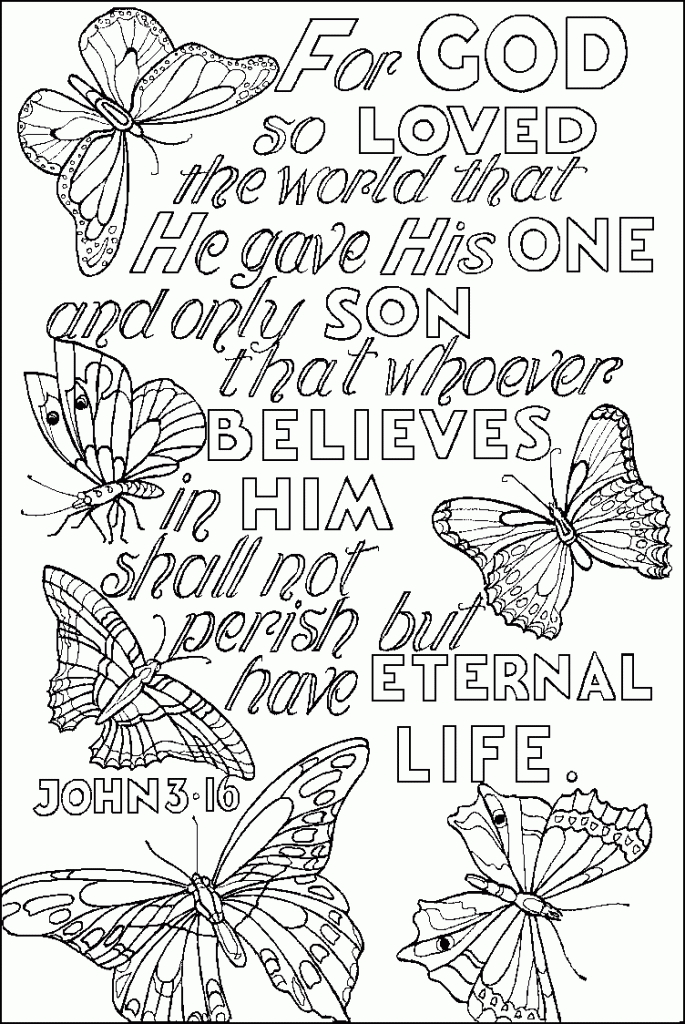
For kinesthetic learners, the above suggestion is also an example of how to incorporate this method. By physically manipulating the words of the verse, you engage in the learning process. Coloring sheets are a way of using kinesthetic learning. Children are especially good at learning kinesthetically. Ever wonder why so many children’s songs have hand motions? Learning sign language for one or more words can help you learn or make up your own. In First Corinthians 13:1 you could pantomime hitting a gong or banging cymbals together.

Here are some more suggestions to help you memorize Scripture:

  1. Pray first. God wants you to memorize His Word, so He will help you.
  2. Get a partner to help you learn. You might even choose your child. After all, you don’t want them to show you up, do you?
  3. Have a copy (or copies) of the verse(s) easily accessible so you can double-check if you need help. Put the copies in places where you can see them frequently and easily, such as on the frig or your cell phone.
  4. Learn the verse in context with the rest of the passage in the Bible. If the verse makes more sense to you, it will be easier to learn.

Hope this will help you in your learning process. I will be giving some more suggestions another time. Have you any ways that help you learn that you can pass on to others?

Special Challenge For February

Many of us know, or are very familiar with, the “Love Chapter” in the Bible…First Corinthians 13. Although it is hard, if not impossible, to select certain sections of the Bible as having the highest priority to memorize, this chapter would certainly make the list.

Love vs. charity

For those of us who grew up with the King James Version of the Bible, we used the word “charity” instead of “love”. According to the Britannica encyclopedia (as found here at https://www.britannica.com/topic/charity-Christian-concept) “Charity, in Christian thought, [is] the highest form of lovesignifying the reciprocal love between God and man that is made manifest in unselfish love of one’s fellow men. ” I like this meaning better, because often “love” is seen as an emotion originating from the person as an individual. But with this definition of “charity” it is a person being a conduit for God’s love. Once more we see love as more than romance or warm, fuzzy feelings. And we have some pretty high standards to live up to if we are to be “charitable” or “loving” to others. Love is patient, kind, does not envy, does not boast, and is not proud, rude, self-seeking, easily angered, and further, keeps no record of wrong, and does not delight in evil. However it shows itself by rejoicing in the truth, and will always protect, trust, hope.

Love Defined…


Is
Is notDoesDoes not
PatientRudeProtectsKeep a record of wrong
KindProudTrustsDelight in evil
HopefulEasily angeredRejoices in truthBoast
The most excellent waySelf-seekingPersevereEnvy

If you have/doBut don’t have love/charityBecause
TonguesBecome resounding gong/clanging cymbalThey will be stilled
Gift of prophecyI am nothingThey will cease
Fathom all mysteriesI am nothingIt will pass away
All knowledgeI am nothingIt is only partial
Faith to move mountainsI am nothingI reason like a child
Give everything to the poorI gain nothingI see as in a mirror
Surrender body to the flamesI gain nothingI see only in part

Hope this might help you in your memorization process. I’d love to see any comments you have!

Lesson 2 February 2021

What’s the first thing you think of when you think of February? Valentine’s Day, of course! Much of what is associated with Valentine’s Day is about romance. However, that isn’t the whole story. In fact there’s a whole lot more to the story. And what is the greatest love story of them all? That Christ gave his life for us. Isn’t that the most wonderful thing ever! Our memory verses focus on this.

The first verse that we are memorizing is probably the best known of all verses in the Bible, John 3:16. This verse along with Genesis 1:1 form a capsule of all the rest of the Bible. Memorizing and thinking about these verses is fundamental to all the rest of our verses!

Little Ones

John 3:16  For God so loved the world that he gave his one and only Son, that whoever believes in him shall not perish but have eternal life.

Help your little ones to understand that God wasn’t giving away his son and you won’t ever give your little one away. You might liken it to Mom or Dad going away on a business trip. For military families this might be compared to a parent going on tour. Please make it clear that this was planned and that the person (Jesus) was part of the decision and this was done out of love for us. Please also make sure they understand that “the earth” means the sphere we live on versus “the world” which refers to people–past, present, and future, including them. This might be a good time to invest in a globe, pointing out where you live. Little ones love to sing and one of the most beloved songs is “Jesus Loves Me”. Here is an adorable version by Listener Kids (with a very adorable carrot flute player).

141) “Jesus Loves Me” With Lyrics – YouTube

Group 1 (Elementary)

John 1:1 In the beginning was the Word, and the Word was with God, and the Word was God.

Learning about how letters are made into words and then reading these words is very important to this age group. Just think about it…the alphabet is just a bunch of symbols until you put various combinations together to create words. A word has meaning, but letters do not (though there are a couple of words that consist of only one letter such as “I” or “a”). Also again using a globe, help them find where they are. Then spin the globe and randomly point to other places and ask them if God loves people who live in each of these places. Absolutely! This might be a good time to talk about diversity.

Here’s another version of “Jesus Loves Me” for this age group (and extra credit for finding the typo!) and something to color.

This image has an empty alt attribute; its file name is sunday-school-coloring-pages-printable.jpg

Group 2 (Seniors)

In addition to the above verses add

John 1:14 The Word became flesh and made his dwelling among us. We have seen his glory, the glory of the one and only Son, who came from the Father, full of grace and truth.

Couldn’t help adding one more adult version of “Jesus Loves Me” , especially if you like bluegrass!

joey and rory jesus loves me youtube

Listen to this for a totally different riff on “Jesus Loves the Little Children” but please pay special attention to the back-up vocals and the drummer!

Jesus Loves the Little Children | Wilson Family

Especially for teens here is a great song to remind you that God really loves you…

Group 3 (Advanced)

To the previous verses add

John 15: 9-13 As the Father has loved me, so have I loved you. Now remain in my love. 10 If you keep my commands, you will remain in my love, just as I have kept my Father’s commands and remain in his love. 11 I have told you this so that my joy may be in you and that your joy may be complete. 12 My command is this: Love each other as I have loved you. 13 Greater love has no one than this: to lay down one’s life for one’s friends.

Now for couples…two very different videos, but both with great messages.

For the story of St. Valentine here is a good video, but, please use parental guidance as this is not intended for children.

The History Behind St. Valentine – YouTube

And now for dessert on this smorgasbord…

(139) A Funny Valentine | Joyce Meyer – YouTube

christian-coloring-pages
For any age (even adults!)) to help learn this verse

Hope you have a very loving February!

7 Excuses People Give to NOT Memorize Scripture

1. I already know a lot of Bible verses and I’ll look them up when I need them. Yeah! But do you know the references to all the Bible verses? I know I don’t and that’s why it’s so important to learn the reference while learning the verse(s).

2. I’m no good at memorization. Join the club. But if God has told us to memorize Scripture, don’t you think He will help you, if you do it for His glory?

3. I’ve tried before and just give up. That’s one of the reasons for this blog-to create a community to interact and encourage one another. Maybe you could find someone to partner with to help you be accountable (and visa versa).

4. I don’t enjoy memorizing. Good for you for admitting that! You also probably didn’t enjoy learning the multiplication tables, either. But aren’t you glad you did?

5. I haven’t got time to memorize. I confess I have to work on this one. (But I do have time to spend on Pinterest.) It’s different from exercising when you want to have a block of time to get the full benefit. Actually memorizing is easier when it’s done in snatches of time.

6. I’m confused about what version of the Bible to use. Some of us “more senior” people remember there being only one version-the King James Version. To be truthful, I still prefer the KJV. However, since so many complain that they can’t understand this version, I suggest the New International Version, because many Bible memorization groups use this version. That’s not to say the version you prefer is “bad” or “inferior”, but keep in mind the importance is memorizing the Scriptures. Just try to be consistent with the version you use.

7. I’ll get to it later. The trouble is, we may not always have a Bible, so the only part of it you will have is what is in your head. (Could you really believe a year ago, that the whole country, and most of the world would be shut down and we’d all being wearing face masks?)

So here are some of my thoughts. What other excuses do you think people give? What do you think about the ones I gave.

Thanks for reading! We will start our next set of verses the beginning of February.

7 Reasons to Memorize Bible Verses

Recently someone asked me why we should memorize Bible verses. This is certainly a legitimate question considering our current access to multiple ways both print and digital. In answer here are some reasons (and certainly not an exhaustive list) I feel that it is important to memorize.

  1. It is vital to our very life. “Man does not live on bread alone but on every word that comes from the mouth of the LORD.” Deuteronomy 8: 3b.
  2. To help us to keep from sinning. “I have hidden your word in my heart that I might not sin against you.” Psalm 119: 11.
  3. It helps us to guide our thoughts in a way that is pleasing to God.  ” For as he thinks within himself, so he is.” Proverbs 23: 7.
  4. Having verses readily available protects us from the devil’s schemes. “Put on the full armor of God, so that you can take your stand against the devil’s schemes. 12For our struggle is not against flesh and blood, but against the rulers, against the authorities, against the powers of this dark world and against the spiritual forces of evil in the heavenly realms. 13Therefore put on the full armor of God, so that when the day of evil comes, you may be able to stand your ground, and after you have done everything, to stand. 14Stand firm then, with the belt of truth buckled around your waist, with the breastplate of righteousness in place, 15and with your feet fitted with the readiness that comes from the gospel of peace. 16In addition to all this, take up the shield of faith, with which you can extinguish all the flaming arrows of the evil one. 17Take the helmet of salvation and the sword of the Spirit, which is the word of God.” Ephesians 6: 11-17.
  5. In these increasingly chaotic, uncertain times we can have a solid point for our thoughts and actions. “All Scripture is God-breathed and is useful for teaching, rebuking, correcting and training in righteousness, 17 so that the servant of God may be thoroughly equipped for every good work.” Second Timothy 3: 16, 17.
  6. Knowing verses helps us when we want to witness to others.  “But in your hearts revere Christ as Lord. Always be prepared to give an answer to everyone who asks you to give the reason for the hope that you have. Always be prepared to give an answer to everyone who asks you to give the reason for the hope that you have.” One Peter 3: 15.
  7. This one is the most important reason. God requires it of us. “Fix these words of mine in your hearts and minds; tie them as symbols on your hands and bind them on your foreheads. 19 Teach them to your children, talking about them when you sit at home and when you walk along the road, when you lie down and when you get up.” Deuteronomy 11: 18,19.

So here are 7 of my reasons to memorize verses from the Bible. There are many others. Please tell me another reason that you have along with Bible reference that displays it. I’d love to hear from you.